Why a Small Room Can Make a Quiet Line Feel Close
Audience distance in a small theatre shapes how a quiet line lands; learn how layouts gather attention and choose a seat that suits your way of watching.

The common mistake is to assume that the nearest seat is always the best one. In a small theatre, audience distance can make a quiet line feel intimate, but a close view may also reveal every glance, breath and shift of weight, leaving less room to watch the scene as a whole. The cost is not simply a less comfortable seat: it can be a mismatch between what you hope to notice and what the room makes easy to see.
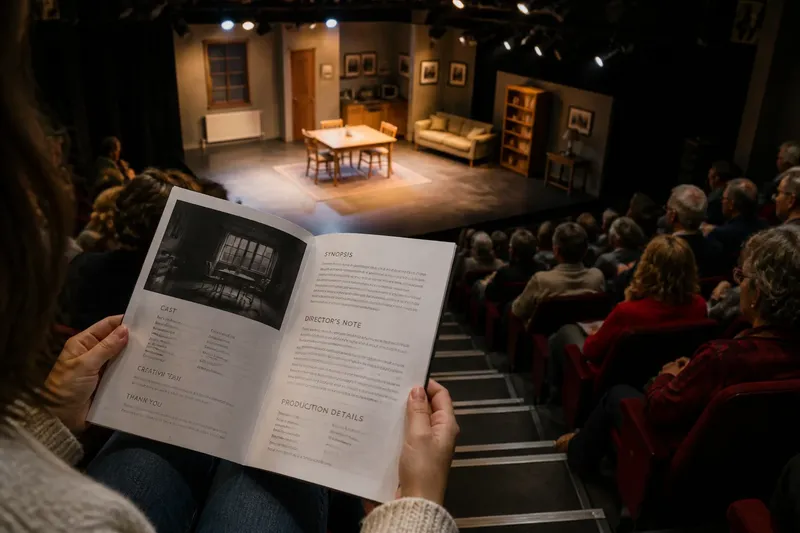
There is no universally best layout. A performer can seem to speak privately to one person from the front row, while a seat further back may make the same line feel shared across the room. The effect depends on sightlines, the shape of the playing space, the actor’s focus and how the audience is arranged around it.
What does audience distance change in a small theatre?
Distance changes the scale at which you read performance. Up close, small movements become legible: a hand held still, a quick change in eye focus or a moment of hesitation before a line. Further away, those details may soften, but you can take in more of the performer’s body and the space around them.
Sound changes too. In a compact room, an unamplified voice may reach you with little apparent effort. From the front, the voice can feel direct; from the back, it may seem to belong to the whole room. Acoustics, background noise and the actor’s vocal choices all contribute, so distance alone does not determine what you hear.
Think of watching a conversation across a kitchen table. A nearby listener notices a raised eyebrow; someone standing in the doorway sees how both speakers relate to the room. Neither view is more truthful. Each brings different information into focus.
How do three common layouts shape attention?
Community venues adapt rooms to suit the show, so the same space may offer different relationships between performer and audience on different nights. Three arrangements are especially useful to compare: a frontal layout, theatre in the round and a flexible thrust or traverse.
What does a frontal layout make easiest to follow?
In a frontal layout, the audience faces one main playing area, much like a shallow stage at the end of a hall. This makes a shared direction of attention clear, and a performer can use the stage picture to guide where you look. It often suits a scene with several people arranged across a space or a production that uses visual details at the back.
The trade-off is that a line or gesture can appear directed towards one part of the audience while another section sees its side. Seats near the edge may have an angled view, and a performer’s back can briefly block a face. If the show relies on fine facial expression, consider whether your seat gives you a clear view of the person speaking rather than only the overall picture.
Why can theatre in the round feel unusually close?
With seats on several sides, the audience shares the room with the action. A performer turning towards one section may seem to address it directly, while others see a profile or the back of a costume. This arrangement can make the space feel active and communal, especially when performers move among or around the seats.
Attention also shifts more often. You may watch a listener’s reaction while a different section has a clear view of the speaker. The room asks you to choose where to look, rather than offering one fixed picture. That suits an audience happy to follow movement and accept that another person’s angle will differ from theirs.
What is distinctive about a thrust or traverse arrangement?
A thrust stage projects into the audience, which sits on three sides; a traverse places two banks of seats opposite each other, with the playing space between them. Both arrangements bring performers close while preserving a strong sense of the scene’s shape. A quiet line can feel exposed because listeners are near, yet it can also travel across the space to people opposite.
These layouts reward attention to where a performer turns and how they use the gap between audience banks. They can be less suited to a scene that depends on everyone seeing the same facial detail at once. Before choosing a seat, notice whether the action seems likely to stay centred or move along the full playing area.
Which seat suits the way you want to watch?
Choose by the kind of attention you enjoy, not by a general rule about front or back rows. If close expression matters most, look for a seat with a direct view of the performers’ faces and enough distance to see more than one person at a time. If you prefer to read movement and relationships, a central or slightly further-back position may make the pattern easier to follow.
- For facial detail: favour a clear, direct sightline, while avoiding a position so close that you must keep turning your head to follow the scene.
- For the whole stage picture: consider a seat that lets you see the performers’ feet, entrances and the space between characters.
- For a lively, shared atmosphere: an aisle or a seat near a turn in the playing area may make performers’ movement feel particularly immediate.
- For fewer sightline interruptions: look beyond the nearest row and consider whether another audience member could block the central action from your seat.
Say you are choosing between the front row and a central seat a little further back for a small-room drama with two actors who cross the space often. If you most enjoy seeing expression at close range, the front row may suit you; if you want to track both actors and their changing positions, the central seat may offer a more complete view. The useful decision is not which seat is objectively better, but which view supports the kind of watching you want.
How can you judge a room before taking your seat?
Start with the playing area rather than the seat number. Is it raised, level with the audience, or surrounded by seats? Do performers enter from a single side, pass through the audience, or use several routes? Those details hint at where action might gather and where a view could be interrupted.
Look for practical information from the venue, such as a seating plan or notes about restricted views. A plan can show the layout, but not always the effect of a particular performer’s height, a standing audience member or a quick turn of the scene. If you need an access arrangement or have a specific sightline concern, contact the venue before booking; staff can explain the seating options available.
Once seated, give your eyes time to adjust to the room’s scale. Notice whether you can see the playing area without leaning, and whether the seats opposite distract you or add to the sense of a shared event. In a small room, the audience itself is part of the view, though a production may direct attention away from it.
What do audiences often ask about small-room seating?
Is the front row always the most immersive?
No. It can make a performer’s expression and presence feel immediate, but it may also limit your view of movement across the stage. A seat further back can give a stronger sense of the scene as a whole.
Does sitting centrally matter in theatre in the round?
There may be no single centre when seats surround the action. Instead, consider which side gives you a useful view of likely movement and whether you are comfortable seeing performers turn towards other sections.
Will a small room make every quiet line easy to hear?
Not necessarily. Room acoustics, audience noise and how a performer uses their voice all matter. A close seat may help a quiet line feel direct, but a clear path of sound and attentive listening matter too.
How can I choose if I do not know the production?
Use the seating plan to understand the layout, then choose according to what you most want to notice: faces, movement or the relation between performers and the room. If the venue has specific sightline or access information, ask before booking.
How should you choose when every view is partial?
Small stages often make the audience’s position visible in the experience, rather than hiding it behind a distant frame. That does not make the view incomplete in a bad sense: one person notices a still hand, another sees a listener’s response, and someone opposite catches the turn that changes the scene.
For audience distance in a small theatre, the most useful question is therefore what you want the room to bring close. A quiet line may feel like a confidence from the front, a shared thought from the centre or part of a larger pattern from further back. Choose the seat that helps you attend in your own way, and let the room’s other angles remain part of the evening.