A Rehearsed Pause or a Quick Reply?
Compare a rehearsed pause with a quick reply in comic timing, and see how each shapes audience expectation, character connection and a scene’s rhythm.
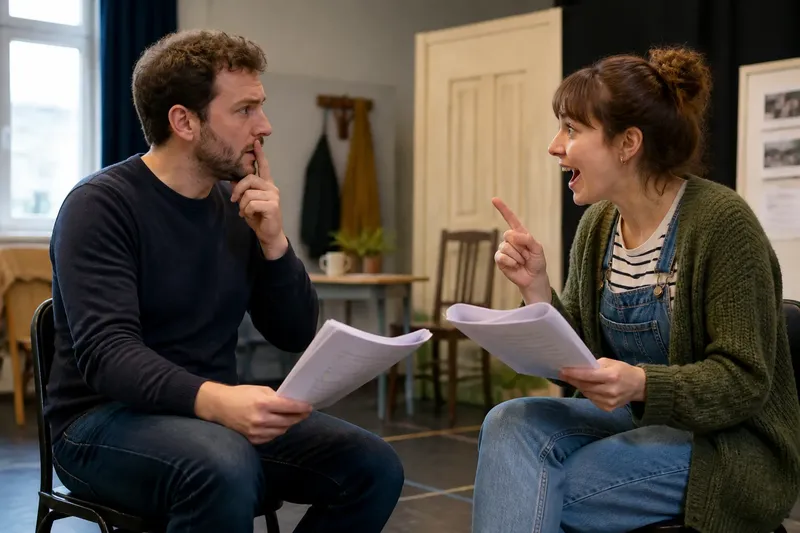
The common mistake with comic timing is to treat every laugh as a cue to wait. In a scene built around comic timing, a rehearsed pause can give the audience room to anticipate a joke, while a quick reply can make a character seem alert, impatient or unexpectedly close to another. Use the wrong rhythm and the scene may feel as if it has stopped to collect a laugh, or as if its characters have not heard one another.
These are not rival rules. A pause is a deliberate gap before or after a line; a quick reply is a line delivered with little or no gap after the previous one. Both can be precise, and both depend on what a character wants in that moment. A week of rehearsal is enough to explore the difference without turning the scene into a timing exercise detached from its story.
What should the first rehearsal week reveal?
Begin by choosing one short exchange in which the characters’ intentions are clear. It might be an accusation, a misunderstanding or a small attempt to impress someone. Mark the lines that carry the setup and the comic turn, then ask what each character is trying to get from the other.
On the first rehearsal day, read the exchange plainly, without adding a pause for laughter. The cast can hear the scene’s natural pace and notice where the meaning already changes. If a line is funny only when delivered with a particular accent or exaggerated gesture, clarify the character’s thought before adding that flourish.
At the next rehearsal, try a held pause at one chosen point. The actor should have a playable reason for waiting: perhaps they are searching for a response, refusing to answer, or watching the other person realise what has been said. A pause without an intention can look like a forgotten line, so the actor’s attention must remain active.
Then run the same passage with a quick reply. The responding actor listens for the other character’s final thought and answers as soon as their own impulse arrives. This can make the exchange feel like a rally: each line changes the direction of the next rather than sitting alone as a prepared joke.
How does a pause shape expectation?
A pause asks the audience to wait with the characters. The gap may let a surprising statement land, invite people to predict a response, or reveal that someone is pretending not to be affected. The laugh, if one comes, belongs partly to that expectation: the audience has had time to imagine what might happen next.
That wait can also change the relationship between performers. A character who holds eye contact after a blunt remark may seem confident; one who looks away may appear embarrassed or caught out. The silence is not empty time. It lets the audience read behaviour that a fast line might cover.
Keep the pause connected to the scene’s action. An actor can listen, assess, or decide during the gap, even if no visible gesture is needed. Like a comma in a spoken sentence, the pause can alter how the words around it are understood; stretch it without a reason and the thought may lose its shape.
When does a quick reply build connection?
A quick reply often makes characters feel unusually familiar with one another. They may share a rhythm because they know each other’s habits, or because one is eager to interrupt and take control. The audience hears not only the joke but the speed of the relationship.
Fast exchanges can also show that a character has anticipated an insult or rehearsed a defence. That makes the reply funny while hinting at insecurity or competition. If both actors race through every line, however, the exchange can become a blur; preserve the words that carry a change in meaning, and let the rest move briskly.
Say a community theatre cast is rehearsing a scene in which one character claims to have prepared a speech and the other asks what it says. In an invented version with a pause, the speaker searches the blank page before answering, “It’s still in my head”; the audience may anticipate the excuse as the search continues. In a quick-reply version, the answer comes at once, making the speaker sound practised and the questioner seem used to this sort of evasion.
What should actors and directors try during the week?
Use a simple rehearsal sequence rather than choosing a rhythm by instinct alone:
- First reading: speak the scene at an ordinary pace and identify the characters’ immediate aims.
- Pause pass: add one intentional gap, then name what the waiting character is doing or deciding.
- Quick-reply pass: remove that gap and let the response come from active listening, not from rushing to the next joke.
- Partner check: ask each actor what they understood from the other’s timing, including any shift in confidence or closeness.
- Audience check: invite a few people who have not rehearsed the scene to describe the relationship they saw, rather than asking only whether it was funny.
- Later rehearsal: repeat the chosen version in context, then keep a pause or quick reply only where it supports the scene’s changing action.
Schedule the first experiments early in the week, while there is time to compare alternatives. In a later run, check whether the timing still works when actors move, handle the scene’s ordinary business or perform for a small invited audience. A rhythm that works in a still reading may need adjustment when attention is divided.
Which comic timing questions matter in rehearsal?
How long should a comic pause last?
Long enough for the audience to follow the thought, but not so long that the character seems to have left the scene. The actor’s attention and the partner’s response matter more than counting beats.
Should actors wait for every laugh?
No. A response can be allowed to settle when it would obscure the next line, but waiting after every joke makes the scene feel segmented. The actors should preserve the exchange’s emotional and verbal momentum.
Can a quick reply still be clearly heard?
Yes, if the actor finishes the line cleanly and directs it to the partner rather than swallowing the words. Speed should come from urgency or familiarity, not from sacrificing clarity.
What if the audience responds differently at each performance?
Keep the characters’ intentions steady and allow a little flexibility in the space after a laugh. Avoid changing the scene’s rhythm in ways that leave the partner unable to hear or answer naturally.
How can the chosen rhythm stay alive?
Once the cast has selected a version, write a brief cue in the script margin, such as “wait for the realisation” or “answer before she can recover”. Those notes preserve the reason for the timing rather than treating a pause as a fixed number of seconds. The actors can then adjust their attention to the room without losing the scene’s logic.
For comic timing, the useful choice is not simply pause or speed. It is whether the audience should have time to anticipate, or should feel swept along by characters who cannot—or will not—wait. Revisit that question whenever a line feels flat: the answer may be a clearer intention, a more alert partner, or a different gap between thoughts.