When the Programme Tries to Tell the Whole Story
A theatre programme can offer context without explaining every choice. Use it as a light companion, so the performance has room to surprise you.
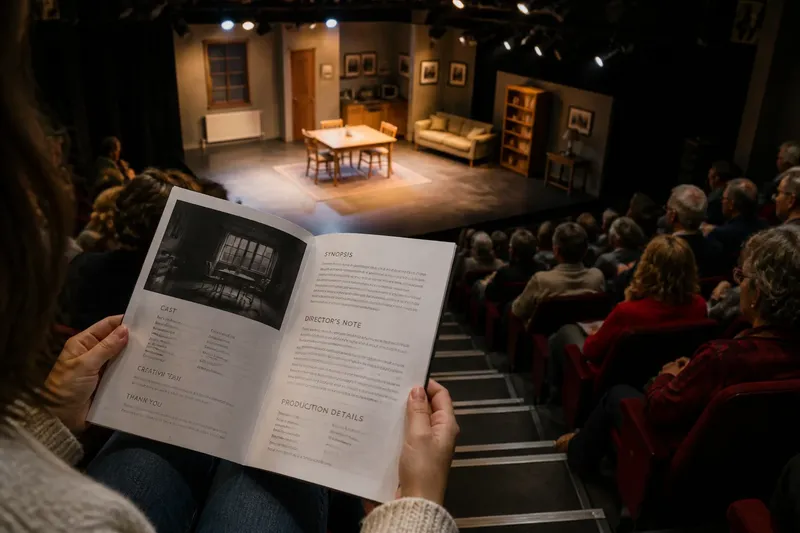
The common mistake with a theatre programme is to treat it as the answer key: read every note beforehand, then watch the performance to check whether you understood it. That can cost you the pleasure of noticing a choice before someone explains it. A programme is more useful as a light companion, offering a little context without trying to tell the whole story.
This is especially true at a community theatre, where a programme may bring together plot notes, cast biographies, acknowledgements, production details and practical information. Each part serves a different purpose. When you ask one small booklet to explain the performance, it is easy to mistake background for a set of viewing instructions.
Why can a programme feel like an answer key?
Programmes often put several kinds of writing close together. A synopsis may tell you what happens; a director’s note may describe an intention; a cast biography may mention previous roles. Because they appear on the same pages, they can seem equally necessary to understanding the show.
They are not. The synopsis is a guide to events, while a note about the production is one person’s account of its approach. Neither can replace the moment when an actor delivers a line or the stage picture changes. Reading every page as essential can make the performance feel like a puzzle with an approved solution.
It also helps to remember who the programme serves. It may thank local supporters, identify the creative team, share access information and give audiences something to keep. Not every paragraph is aimed at interpreting the action. A list of names can be valuable without telling you what a scene means.
What if the synopsis gives away too much?
A synopsis varies in how much it reveals. Some stop after setting out the situation; others describe turns in the story or explain the ending. If you prefer discovery, look for a contents page or a short description, and leave the fuller plot note unread until after the performance.
In a small venue, you might have the programme in your hand while waiting for the lights to dim. If an opening summary begins to reveal an outcome you would rather encounter onstage, close the booklet and return to it later. There is no obligation to finish a page just because you started it.
When a plot detail is unclear during the show, give the scene a chance to supply it. A character’s name, a change of allegiance or a reference to an earlier event may become clearer through the dialogue. If it remains confusing, the synopsis can help at the interval or afterwards; it need not be consulted like a running commentary.
What if the director’s note tells you what to notice?
A director’s note can offer helpful context, but it is not a rulebook for audience response. It may explain why the production uses a particular setting, what question the team kept returning to, or how a familiar script has been approached. Those details describe the makers’ thinking; they do not require you to see every moment in the same way.
Try reading just the part that answers a question you already have. If you are curious about a stripped-back set, a note may explain why the team chose it. If you would rather meet the production without a prompt, leave the note for later. Either choice is reasonable, and the booklet will still be there.
It can help to separate a stated intention from what you observe. Suppose a note says the production is interested in family loyalty, but you find yourself paying attention to how characters avoid difficult conversations. Both observations can sit alongside each other. You do not have to adjust your response to fit the wording on the page.
How can you use the programme without missing the show?
Think of the programme as a map tucked in a coat pocket: useful when you need it, but not something to keep between your eyes and the road. Before the performance, choose only the information that helps you settle in. During the show, keep the booklet closed unless you need a practical detail or there is a planned interval.
A simple order can make the booklet feel less demanding:
- Before the show: check the title, running order if provided, access information and any content note that is relevant to your needs.
- For a little context: read a short synopsis if you want one, and stop before details you would prefer to discover.
- During the performance: watch and listen rather than searching for explanations in the programme.
- At an interval: look up a name or plot detail only if it would help you follow the next part.
- Afterwards: return to the director’s note, creative credits or acknowledgements with the performance fresh in mind.
This is not a required routine. It is a way to give each part of the booklet a suitable moment. If you enjoy knowing the story in advance, reading the synopsis beforehand may make the experience more comfortable; if you prefer surprise, set it aside.
What if a name, scene or stage choice is unclear?
Uncertainty is not always a sign that you have missed something. A play may introduce several characters quickly, refer to an event that happened before the action begins, or leave a relationship deliberately unsettled. In a community production, the programme may include a cast list with character names, which can be a handy reference without serving as an interpretation.
Say you lose track of which character has just entered after a change of scene. At the interval, you glance at the cast list and notice the name beside the actor you remember from the opening; the next scene is easier to follow, while the character’s motives remain yours to consider. The programme helps with a concrete point of orientation, not with deciding what the scene must mean.
If a stage choice puzzles you, notice what it does before looking for a reason. A repeated object, a bare playing space or a sudden shift in lighting may become more legible as the action continues. Afterwards, a production note or conversation with another audience member can add context, but neither needs to settle the question completely.
When a programme contains an unfamiliar term, first ask whether it affects your understanding of the immediate action. A role title or production credit may be useful to know; a technical term may simply describe how a team worked. You can look it up later rather than interrupting your attention during a scene.
When should you read the credits and production notes?
Credits are often most rewarding after the performance, when you can connect names with what you saw. They show how many people contribute to a production, from performers and designers to stage management and front-of-house volunteers. Reading them afterwards can turn a general impression into a more specific curiosity: perhaps you want to know who designed the costumes or arranged the music.
Production notes may also be easier to read once you have your own response. A note about a local setting, a design constraint or a collaborative choice can add a layer without taking the place of your first impressions. If the show prompted a question, use the note to explore it; if it did not, there is no need to search for one.
For practical details such as access arrangements, late seating or photography rules, the programme may be useful before the performance. Follow the venue’s posted guidance and any specific instructions given by staff. Interpretive writing is optional; information that affects your visit is a different matter.
Which programme questions are worth asking?
Should I read the synopsis before the show?
Read it beforehand if knowing the plot helps you relax or follow the action. If you enjoy surprises, check only the brief description and leave plot details until later.
Is the director’s note the correct interpretation?
No. It offers the director’s perspective on the production, not a required response from the audience. Treat it as context you can compare with what you noticed.
Can I look at the programme during the performance?
You can, but frequent reading may pull your attention away from the action and sound. If you need to check a cast name or other detail, an interval is often a less distracting moment.
What should I do with a question the programme does not answer?
Keep the question, and see whether later scenes change how it looks to you. You can also discuss it afterwards or ask whether the company has shared further production notes.
How can the booklet remain a companion?
Use the programme to support the kind of attention you want to bring, not to set a standard for how much you should understand. A cast list can orient you, a synopsis can reduce uncertainty, and a note can provide background. None of those pages needs to speak over the performers.
If you are choosing how to read a theatre programme, start with the practical information, then decide whether you want a small amount of plot context. Keep the rest for the interval or the journey home. That leaves room for the performance to make its own first impression—and lets the booklet add useful detail afterwards, rather than trying to tell the whole story in advance.